On April 22nd 2020 we hosted an online event on the epigenomics of immunity.
Florian Wimmers PhD, Postdoctoral Scholar in Systems Immunology at Stanford School of Medicine gave a talk “Does the epigenome remember your flu shot?”.
Does the epigenome remember your flu shot?
Florian introduced us to the immune system, and the differences between adaptive and innate immunity. We know that adaptive immune system develops memory in response to infections or vaccines, and thanks to that is able to respond to future infections.
But it is the innate immunity that puzzles researchers today. Innate immunity, historically considered to be generic and not able to develop memory, now appears capable of carrying epigenetic memory of past vaccines, resulting in potentially enhanced immune activation in response to a broad range of pathogens.
Florian shared his research on the epigenomics of innate immunity, where, among other experiments, he used EpiTOF technology to map changes in a comprehensive panel of histone modifications. His findings shed light on how innate immunity may remember its past challenges (e.g. vaccines), and therefore respond more robustly to new infections.
Given Florian’s expertise, I asked if he could tell us about COVID-19 as well. While many of us shelter in place these days, Florian is already working on a new project related to COVID-19.
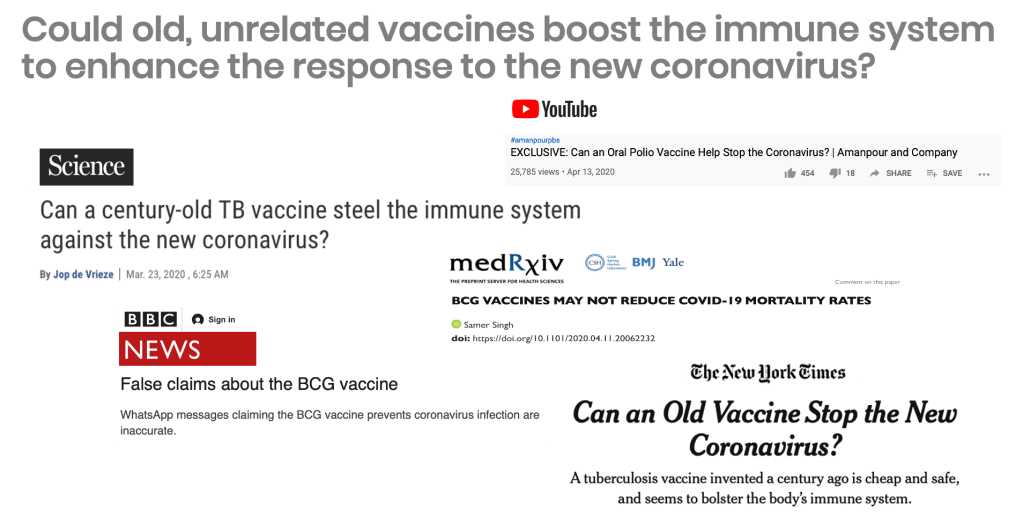
Florian gave us an overview of how the novel coronavirus infection works, and debunked some myths. In particular, he explained why researchers are trying to use already-existing vaccines, such as BCG, to help fight the COVID-19 pandemic, and why we need to wait for the results of ongoing clinical trials before we know if this approach is going to work.
Further reading
If you want to learn more, here is some further reading suggested by Florian:
Trained immunity: A program of innate immune memory in health and disease
mTOR- and HIF-1α–mediated aerobic glycolysis as metabolic basis for trained immunity
Questions, questions
A lively discussion ensued after Florian’s talk, and you asked whether we could post the questions, to continue the group discussion. (Unfortunately, we did not capture the questions in the live discussion, or the answers.) Please feel free to start the discussion threads in the comments below!
Related to epigenetics of innate immunity:
How potent is epigenetic memory in innate immunity? Do those changes sustain through lifetime?
How do you prove that the mechanism of innate immune activation is epigenetic rather than cytosolic, or the result of transient upregulation of surface receptors etc.? are innate immune epigenetic changes inherited through cell divisions?
Is adjuvant alone sufficient to induce the epigenetic response?
Are there any small molecule immune potentiators (SMIPs) of this effect?
Has anyone looked at other hormetic factors in making epigenetic changes to immune cells? Examples include exercise, hot/cold temperatures, caloric restriction, etc.
Do the epigenetic responses, indicating activity of particular sets of genes in immune cells, suggest specific (precursor) mechanisms for integration / generation of adaptive immunity?
Are there published results relating exposure of specific adjuvants to sets of epigenetic changes in adaptive cells?
An attendee comment: Different Adjuvants Induce Common Innate Pathways That Are Associated with Enhanced Adaptive Responses against a Model Antigen in Humans
Related to COVID-19:
There are reports that widespread vaccination with BCG vaccine particularly strains used in certain countries could help populations in handling SARS-Cov2. It is evident in fatality rates between different countries. Could you comment on this, is it being possible or is this mostly just correlation?
Is it possible that other confounding factors (such as higher number of NK cells, as noted in some public forums) are in fact responsible for better response in these COVID-19 trials (as opposed to epigenetic memory)?
Is there any indications yet about how much the repurposed vaccines might shorten coronavirus course in a healthcare worker, for instance?
 Bio Bay Area
2 thoughts on “BACE event on Epigenomics of Immunity”